|
|
DERBYSHIRE RADIO
CONTROL FLYERS
|
|
CLUB HANDBOOK
Introduction
This handbook sets out the rules for running the Club and contains maps for its two current flying sites at Ashbourne Airfield and Longford Hall Farm
Club Rules
1 The Club shall be called the DERBYSHIRE RADIO CONTROL FLYERS.
2 The Club shall operate from Ashbourne Airfield, Longford Hall Farm or any other designated site.
3 The objective of the Club shall be to encourage and promote the interest of building and flying radio-controlled model aircraft.
4 The Club shall consist of Senior and Junior Members. Junior Members must be under 18 years of age. Members who are over 18 on 1 January and are in full time education, may retain Junior Membership, but must provide a copy of their current NUS card or equivalent. Junior members under the age of 16 must be accompanied at the flying site at all times by a family member, parent, guardian etc. who is responsible for their health and safety, behaviour and their equipment and belongings.
5 The election of members shall be by a majority decision of the Committee.
6 New Senior members on election shall pay a joining fee of £50. The joining fee will be waived for new Junior Members. A Junior Member who transitions to Senior membership will not be required to pay a joining fee.
7 The annual subscription shall be paid by 1 January. The annual subscription fees shall be announced at each Annual General Meeting (AGM). New members elected in August, September, October, November and December shall pay a reduced subscription. There shall be no annual fee for a Junior Member where a family member is also a Senior member of the Club. Where there is no family member of the Club, the Junior Member fee will be 40% of the Senior Club membership subscriptions.
8 Any member whose subscription has not been paid by 1 January must not fly at any Club designated site and shall be deemed to have left the Club. Re-joining after this date shall incur a Re-joining Fee of £10 in addition to the normal annual subscription. The £10 Re-joining fee shall be applicable up to the fifth anniversary of leaving the Club, after which time the full joining fee shall be applicable. Flying may be resumed once the full subscription due has been received by a Club Officer.
9 The Club shall be affiliated to the British Model Flying Association (BMFA). All Club members, Junior and Senior, must be members of the BMFA.
10 Any member who has not renewed their annual BMFA subscription by its expiry date must not fly at any Club designated site as the BMFA insurance applicable to both the member and the Club will not be valid. Flying may be resumed once confirmation of current BMFA membership has been received by a Club Officer.
11 All Members (Junior and Senior) must comply with the latest Civil Aviation Authority (CAA) registration requirements. This includes paying applicable fees and taking required tests (currently CAA DMARES or BMFA RCC) to obtain their Operator and Flyer ID numbers. All members models weighing more than 100g, and flown at any Club designated site, must display their Operator ID on their aircraft in accordance with CAA requirements. It is the individual responsibility of members (Junior and Senior) to fly lawfully and within the legal requirements of the CAA. It is not the responsibility of the Club to ‘police’ this legal requirement.
12 The Officers of the Club shall be Chairman, Secretary, and Treasurer. The role of Membership Secretary shall be carried out by one of the Officers. Should any Officer, for whatever reason, wish to stand down, the Committee may appoint a Deputy who will enjoy the full powers of the office, with the exception of online bank account access, until the next AGM.
13 Management of the Club shall be vested in the Committee, composed of the Officers and a minimum of four elected members. A member may be co-opted onto the Committee to take the place of a member who has left the Committee, to cover for short-term absence or to bring a specific skill to the Committee. The co-opted member shall be approved by a majority vote by Committee members.
14 Four members of the Committee, two of whom shall be Officers, shall form a quorum.
15 The AGM shall be held in November or December. The business of the meeting shall be: -
a) Apologies for absence
b) Approval of the Minutes of the previous year's AGM
c) Matters arising
d) Approval and adoption of Annual Reports from the Committee
e) Adoption of Accounts
f) Election of Officers and Committee
g) Any member's proposals received under Rule 16
h) Any other business
16 If two members make a written request to the Secretary before 24 October stating a motion to be proposed, the Secretary shall give notice of the motion in the notice convening the AGM.
17 An Extraordinary General Meeting (EGM) may be called by the Committee at any time as deemed necessary. An EGM shall be called if a written request is received by the Secretary, which states the motion(s) proposed and is signed by five or more members.
18 At least 21 days before the AGM and at least 14 days before an EGM, the Secretary shall send to every member a notice stating the date, time, location and agenda of the meeting. No business other than that specified in the notice shall be transacted at the meeting.
19 The quorum of an AGM or EGM shall be ten members. If a quorum is not present, the meeting shall be adjourned for two weeks. The Secretary shall notify all members of the adjournment. The adjourned meeting may proceed without a quorum.
20 The Chair at all General Meetings shall be taken by the Chairman. If he is not present after 5 minutes of the appointed start time of the meeting, the Chair shall be taken by a Club member elected by the meeting.
21 Every member shall have one vote; the Chairman shall have the casting vote.
22 In the event of dissolution of the Club for any reason, assets remaining after the Club’s liabilities have been discharged shall be divided equally amongst the current members, providing that they have five full consecutive years as a member.
23 Membership of the Club may be terminated at the discretion of the Committee for blatant disregard of the Club rules.
24 The Club shall have a bank account; the signatories shall be the serving Officers of the Club.
25 All frequencies in the 27, 35 and 459 MHz and 2.4GHz bands may be used for fixed wing aircraft, helicopters and multi-rotor aircraft.
26 New members may not fly petrol-engined models. Existing members (prior to 2026) may continue to fly such models provided they comply with current noise limits.
27 Airfield Discipline – General
a) Noise
· Where practicable, IC engines shall be fitted with an effective silencer to comply with current noise limits.
· Small engines of 2cc or less, not designed to be used with a silencer, may only be operated if they comply with current noise limits. As engines of this size can emit a distinctive high-pitched exhaust note that may attract complaints, this will be taken into consideration as part of the noise assessment.
· Any aircraft deemed to be excessively noisy shall be assessed by at least 2 members of the committee. At their discretion, the assessment may involve monitoring by a noise meter using the methodology and limits in the Department of the Environment’s Code of Practice on Noise from Model Aircraft.
· Any member not complying with this rule may be instructed to cease flying by any Committee member present.
b) All accidents and Critical Incidents must be reported to the Committee and an Accident Report Form completed and sent to the BMFA.
c) Take care to minimise damage when entering the crops to retrieve a model. Use the tractor tracks whenever possible.
d) All children and pets must be kept clear of the take-off and landing areas and must be kept under proper control at all times.
e) Members are responsible for their own and their friends’ safety and for the removal of litter.
f) Spinners, propeller safety nuts and all projections forward of the propeller shall be rounded - no needle noses.
g) When flying, all pilots must stand together in the pilots’ area, which should be sited at least 3 metres away from the pits, in both the crosswind and upwind directions.
h) The prevalence of larger models results in quantities of flammable fuels being in the pits. To reduce the risk of fires, smokers must move away from the pits to a safe area. Whenever petrol or gas turbine models are being operated, a fire extinguisher suitable for use on petrol fires and a fire bucket must be to hand and ready for immediate use.
i) Bona fide guests who are BMFA members may fly at either site on a maximum of 3 occasions in total per year, subject to approval by a member of the Committee on each occasion.
j) Due to the potential risk of mobile phone transmissions corrupting the memory of computer type transmitters and the distraction that may be caused, sensible precautions should be taken when using mobile phones:
· Phone calls should not be made or answered in the pits area; move away from the pits area if receiving a call.
· Phone calls should not be made or answered in the pilots’ flying area.
· When lone flying, pilots should keep a mobile phone with them for use in an emergency.
k) No member shall fly unsupervised until he/she has passed at least the appropriate BMFA "A" proficiency test for the class of aircraft being flown unless flying alone or with the agreement of all other members present. The member’s proficiency rating will be shown on his/her membership card, which will be reissued annually. This card must be displayed on the member’s flight box or stand.
l) No more than six aircraft may be airborne at the same time. Helicopters flying from the main site count as one of the six.
m) Fail-safe systems on any model should be set to close the throttle to the idle position (stop, in the case of electric power) upon loss of signal.
o) Aircraft weighing 7 kg. or more must be fitted with a fail-safe mechanism. The pilot must hold at least a BMFA "B" proficiency rating.
28 Airfield Discipline – Ashbourne Airfield
a) Access to the airfield must be gained only as directed by the Committee. Current access is via the gate off Harrison Way.
b) All members must lock the gate on entry to or exit from the airfield.
c) Vehicles must be parked behind the container, extending down the approach road as necessary. Vehicles may be taken into the pits for loading and unloading, but should be removed as quickly as possible.
d) Flying over the pits area, container, lorry park and car park is NOT permitted. Models must not taxy out of or into the pits area. Whenever the pits are located on the west side of the runway, models must not be flown through the gap between the pits and the container.
e) When grass mowing is taking place, flying may only take place to the west of the white line designating the normal pits area, extended for the full length of the patch. Any pilot who does not feel capable of staying within this area, because of wind direction, model type or personal competence, should not fly.
f) Flying Limits
· The main flying area is between the north / south runway and the airfield perimeter in the direction of Ashbourne over Bradley Wood.
· The main east/west runway marks the limit of flying to the south.
· The first hedgerow visible to the east of the main flying area marks the limit to the east.
g) Flying of gas turbine powered aircraft
· Only existing members (prior to 2026) may fly gas turbine models
· Operation is subject to the prior approval by the Committee and endorsement of the member’s DRCF membership card.
· The BMFA Code of Practice for operation of gas turbine powered aircraft must be followed.
· The pilot must hold at least a BMFA "B" proficiency rating.
h) Flying times shall be between 10:00 a.m. and 5.00 p.m. or at the discretion of the Committee. This restriction does not apply to gliders and quiet electric-powered models.
29 Airfield Discipline – Longford Hall Farm
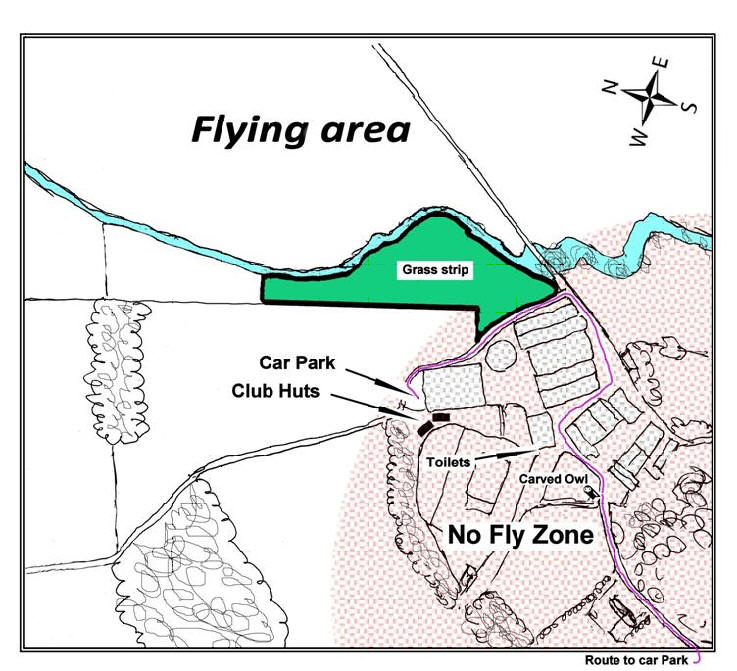
a) Access to the site must be gained only as directed by the Committee. This is currently as shown on the Longford Hall Farm map. Drive slowly through the farmyard and under no circumstances use any other access.
b) Vehicles must be parked in the designated car park. Cars must not be parked by the toilet block, as to do so may restrict the passage of lorries. Vehicles may be taken into the pits for loading and unloading, but should be removed as quickly as possible. Ensure that the vehicle is in motion before moving the steering to prevent damage to the grass.
c) Flying Limits
· The main flying area is east of the take-off/landing area.
· The track leading to the car park marks the limit to the west.
· Flying over the pits area is NOT permitted.
d) There shall be no flying when grass mowing is taking place.
e) Flying of gas turbine powered aircraft is not permitted.
f) The site is noise-sensitive. Any large petrol-engined model which is potentially noisy must be flown first at Ashbourne Airfield for assessment of the noise level.
g) Flying times shall be between 10:00 a.m. and 5.00 p.m. or at the discretion of the Committee. This restriction does not apply to gliders and quiet electric-powered models. Members shall not arrive at the Longford site after 19.30. Any member already flying should clear the site by 21.00.
30 The Committee may amend the rules as necessary, but no resolution to wind up the Club may be passed except by a 2/3 majority at a General Meeting.
31 This issue of the Club Handbook supersedes all previous issues. Repeated failure of a member to conform to the rules, when requested by a committee member, will result in a written warning to the member. Further failure could lead to membership being withdrawn. A record of a member's verbal and written warnings will be kept for 12 months
DERBYSHIRE RADIO CONTROL FLYERS
ASHBOURNE SITE MAP

PILOTS’ AREA AND PIT POSITIONS
The grass area on the patch provides us with increased scope to cater for varying wind conditions, longer take-off runs and the ability to land models without wheels safely. The drainage of this land is not very good, so the Committee has ruled that cars should not be driven onto the grass.
To obtain maximum versatility, members should practice and be able to take off and land from the left and the right, either to the front or rear of their model. For most wind directions, the pilots’ area sited at position #1 should be used, with the pits between the pilots’ area and the container. Pilots’ area position #2, with the pits on the west side of the runway, should only be used in the case of a wind in the East to South quadrant.
DERBYSHIRE RADIO CONTROL FLYERS
LONGFORD HALL FARM SITE MAP

DERBYSHIRE RADIO CONTROL FLYERS
ASHBOURNE SITE MAP
PILOTS’ AREA AND PIT POSITIONS
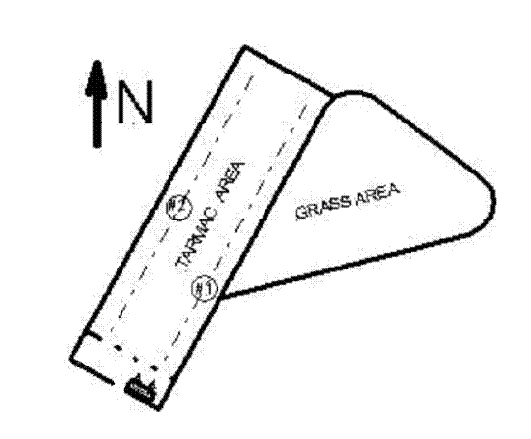
The grass area on the patch provides us with increased scope to cater for varying wind conditions, longer take-off runs and the ability to land models without wheels safely. The drainage of this land is not very good, so the Committee has ruled that cars should not be driven onto the grass.
To obtain maximum versatility, members should practice and be able to take off and land from the left and the right, either to the front or rear of their model. For most wind directions, the pilots’ area sited at position #1 should be used, with the pits between the pilots’ area and the container. Pilots’ area position #2, with the pits on the west side of the runway, should only be used in the case of a wind in the East to South quadrant.
DERBYSHIRE RADIO CONTROL FLYERS
LONGFORD HALL FARM SITE MAP